

Every writing assignment should include a challenge for the writer to solve
Instead of staring at a sheet of paper or a screen, give yourself a writing goal to solve, a problem to solve, or one of these strategies to get started. Or start with a question, then solve it.
I know what you are thinking. This would be so easy to plug into AI to complete the assignment. But here’s the thing—my students created all the elements first, and I threw in three random words they had to include or their story wouldn’t be graded. So they had knowledge, confidence, experience (see below) and a creative challenge, and guess what? They thought it sounded fun, and had learned the art of writing the way they wanted to do it, not the way someone told them to.
Here is the assignment I gave them, but you can generate your own, too:
Writing the short story
NAME___________________________________
Period_____________ Date __________________
I. Required elements
___A can of Diet Coke, something squishy, a knife
___At least three elements from your writing exercises (dialog, characters, settings)
II. Your story must include:
___Description of character
___Character’s name
___Setting
___Point of view (Voice (“I” or first person, “You” or 2nd person, “he or she” or third person)
___Dialogue
___Plot/Action (what happens)
III. Logistics
___1,500 words — About six typed, double-spaced — 12 pt.
___Proofread or spell-check for errors
___Turn in two copies of your story:
___Attach CIM Work Sample Sheet to top of one story
___Attach writing exercises to back of second story
FINAL DRAFT due Friday.
STEP-BY-STEP TIPS :
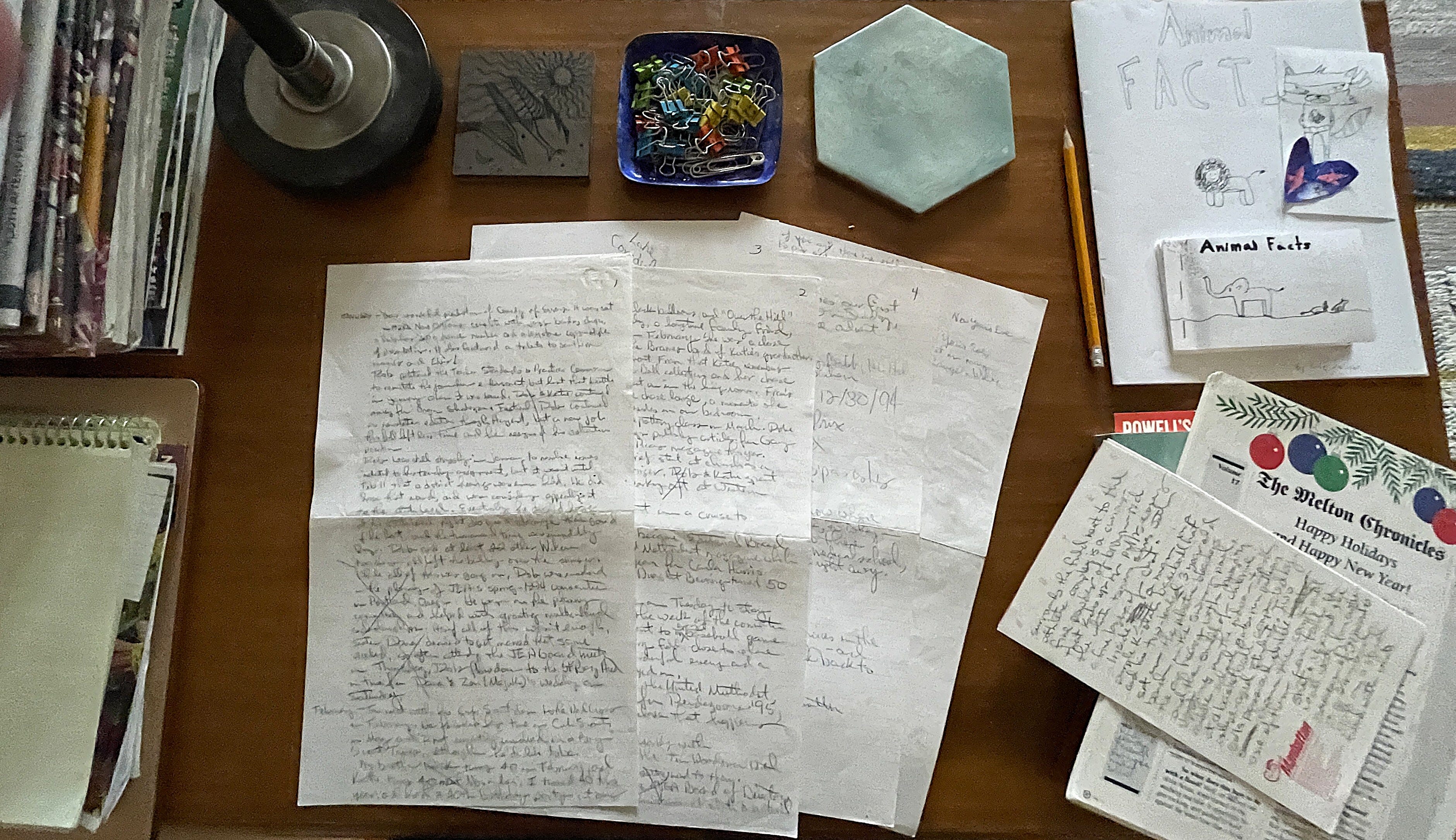
Give yourself an assignment. “Write a list of everything I loved doing with Grandma and Grandpa” or “Make a list of all the fun things I did with Grandma and Grandpa as a kid” or make up your own. In this case, I gave my willing cousins and family a prompt, and they wrote back with their memories. Often that is enough to get started:
One cousin wrote: “Grandma and Grandpa—Ed Sullivan, Lawrence Welk, the “Lemon” Sisters, Bobby and Sissy (?), Topo Gigio….dinner at some cafeteria where we each had a tray, drives around Lake Merritt, coal fires, sleeping on the couches, stringing popcorn for the Christmas tree, drinking tea (picking out my favorite cup from the closet), Grandpa chasing any fire truck siren that went off when we were in the car, g’pa calling the guy who carried out his groceries, canned spaghetti and canned peas for dinner, g’pa bringing us eskimo pies to the TV room, G’pa tying a string on our toe when we were asleep and following it to a package of butterscotch lifesavers or a banana when we woke up, the tickle machine, visiting Mimi and Fifi when they lived across the street (?), brushing g’ma’s hair, “swimming” in the “pool” in the back yard, climbing the magnolia tree, sitting with g’ma on the green striped swing in the backyard …the list is endless.”
See my story about grandma and tea, for example:
Take each item on the list and write down everything you remember about each one, one at a time. Write down everything you can see, hear, taste, touch, and smell. That will trigger more memories, believe it or not. It doesn’t have to be in narrative form. In memoir, which is what this is—truth based on memory—there are always TWO narrators: The one living through the experience for the first time, and the older, wiser narrator who now understands the significance, or truth, of that experience. Notice which one you are using as you write. In one sentence or one paragraph, believe it or not, you can go back and forth between the past and the present narrators. Think of the TV show “The Waltons” with John Boy. The show always started and/or ended with him reflecting back on something, and then the story unfolded.
Now choose one item from your list to develop further.
Use one of the many warm-up activities below to get started.
Write your story the way you remember it. We believe that we all remember a story the same way—but we don’t. A radio show on NPR proved this point. A mother and two daughters all experienced a dramatic event, and an editor was assigned to each one of them and they were instructed not to discuss their story with the others. They heard their three stories when the show aired—and the only thing that was the same was the one event they had all agreed to include. (We could do this in a future activity.)
Write your sentences with picture nouns and action verbs. It’s how you flex your writing muscles.
Structure tip—Find the structure, tone, or approach that helps you tell the story best. Aristotle advised to “Start in the middle.” Sometimes a story within a story works best. Sometimes an unexpected twist or observation works best. You decide!
Don’t worry about spelling or editing until the end (it uses a different part of your brain)—That comes last after you are pleased with your story! If you are not pleased with it, what is the point of crossing your t’s and dotting your i’s? :) Most of my stories go through multiple drafts, I’m not going to lie. I usually have to let my brain rest before I can look at what I’ve done with fresh eyes, and that can result in dramatic changes that make a big difference; if not, you can always go back to your first draft!
Give yourself a deadline. I find time every day to write. Sometimes it’s short, sometimes it’s long. What motivates you to get started is an awaiting audience. Picture your audience, and write to please them, too.
Share with your audience! Find your community who are supportive and fun-loving, and encourage conversation about the stories you want to share share. REPEAT.
Over the years I listened to and studied the craft of how writers experiment and get started. I wrote everything down in my notebook, and created these assignments and activities to get started.
Crafting the Narrative
Assignments and Activities For Writers by Writers
The general format in my classes was a three-week workshop in which students do a number of structured freewriting assignments and activities and expand one of their pieces into a 3-5 page, 1,000-word short story that uses dialogue, description, narrative summary, and action. You get to create your own personal workshop here!
Choose three random items from the list below to get started. Don’t think about it too long. I recommend starting with 13, 28, and 34. Or your own.
TO GET STARTED, STRATEGIES FROM WRITERS:
1. Cover your eyes when listening to a story. Listen for the one best line out of the piece and memorize it. Write it down, or say it back to the author.
2. Get past sight information, and use smell, taste, touch. (Use highlighters in different colors, one color for each of the senses.)
3. Use stage directions to naturally move a character through a scene.
4. Use telling details.
5. Use mood/attitude to create subtext.
6. When you are crafting your plot, take the advice from film school: Something that happens to turn the action around and send it in another direction. Start the story with action. Initially, it needs to be something that frustrates your character. What does your character want? Why can’t they get it now? Keep repeating those questions until the end.
7. Three essentials when creating an invented character (when in doubt, make it up): 1) the character is defined by what he or she look like — physicality, dress, smell (too much cologne); 2) how they behave, what they do, action; and 3) how he/she speaks, talks, or not, can be implied; what they say.
8. Point of view: Recommend first or third person. Writers struggle with who to have tell the story. A lot of contemporary writers use first person. Traditionally third person omniscient. Write first person point of view from your character the first day. On the second day, turn it around so the he or she in your story becomes the I looking at your character.
9. The longer a piece, the more companionable you need to be. Short pieces are better if they are weird and short.
10. Part of being a writer is being an actor. This is the energy, engine of a story. You always want drama.
11. Advice: Nobody in their heart of hearts wants to read about religious or political views they don’t agree with.
12. As a writer, you are always looking for a balance between what is familiar to your readers and what is foreign to your readers. The more foreign what it is you’re talking about, the more familiar elements must be. People are curious about things they don’t understand or haven’t been through.
In freewriting, be quiet and listen for your inner voice. Let it guide you. Follow its lead.
GETTING READY WRITING EXERCISES:
13. Pick one of the following that describe a character, and write a 1-1/2 page story: paranoid, in love, depressed, obsessed, a miser who has won the lottery. The story must be in first person. It is 4 p.m. on Christmas Eve, and the character hasn’t done any shopping yet. The character goes to the mall to do shopping for one hour. Everyone writes the same scene.
14. Identify three things that make you angry or afraid, and write a paragraph. You cannot say “I am afraid of rats....” Say, “When I was a child I enjoyed the dark until....”
15. Brainstorm a list of 6 story ideas. When you find something interesting, your mind and heart sit up and take notice. There is a place where good writing comes from. The only good writing you will do is what interests you. Start with something meaningful and embellish it from there.
16. Clip full page magazine photos of one or two people without advertising or words on the page. (Pass out photos of the characters from the magazines for groups.) Starting with the character’s name, write a present tense narrative. Collect descriptions. Tack pictures to the wall. Read descriptions and see if the class can guess which descriptions match which photos. Think about how effective it is to describe your subject in that moment. Underline your favorite sentence in the story.
17. Write a profile about a person, about who they are stripped of what they usually project. To tell the truth is the highest purpose of a writer. What makes great writing is that it rings true.
18. Give each writer a piece of paper with a word on it that could be a personality characteristic. Describe this person eating in the cafeteria using this characteristic. Think about what they’re eating and how they are eating it. The words to choose from are: lovely, nervous, creepy, dumb, content, sick, shy, pathetic, joyful, anxious, child-like, clumsy, polite, hungry. You have to describe the person without using the word you received. Telling takes us out of the actual moment. When you are writing, freeze the moment, then take your time and expand it.
Words I’ve used: lovely nervous creepy dumb content sick shy pathetic joyful anxious child-like clumsy polite hungry restless greedy scary lazy restless lonely sad depressed crazy starving messy dirty sexy prep jock sultry lovely nervous creepy dumb content sick shy pathetic joyful anxious child-like clumsy
19. Take five minutes to visualize a memory—a really small moment, such as sitting at the table eating cereal, and make a story out of it. First person, about you. Freeze time and recreate the moment.
20. Group story. Start with a noun and end with a word or phrase on a note card or sticky note. Must all be in the same setting. Leader writes beginning and ending. What student gets is the last transitional sentence, something like: “I am a ____.” “but she was afraid of _____.” “She heard a _____.” “She screamed and it was a _____.” “...much like a _____.” Each student’s segment begins with a noun. This is a good activity to illustrate plot turns. Disneyland makes a good setting. Written in first person. A motivation word for character helps, too.
21. To develop descriptive writing awareness, take a famous name and put it on a card, and stick it on a student’s back. The student has to figure out who he/ she is by asking questions about who they are (except name of person).
22. Think of someone you met who had a strong impression upon you, or make up somebody. Take that person and begin writing imaginatively. Divide into groups. Read to each other. Listen/look for: 1) what strikes you most about what you hear, the thing you spark to, the most interesting. 2) what’s missing. Reader/ listener will pick up more about what’s missing “I want to know more about.” Pick one story from each group to read to the class. Cover your eyes while listening to the story. Choose a “telling detail”, listen for a solid, conversational voice.
23. Set-up is important. Get past sight info. use smell, touch, taste. Stage directions. Naturally move character through a scene, using telling details.
24. Come up with six ideas of stories you could write about now. By the end of the session, settle on something. From your six ideas, present 3 to your group. “This is the part where I will leave you at the trailhead.”
25. Come up with a good first sentence. A good opening should intrigue the reader, creating questions, as in To Kill A Mockingbird. Make them read the second sentence, then the third.
26. List the things you’ve memorized.
27. Tell a story about a lie you’ve told.
28. Write down a secret on a sheet of paper. No names, please. Throw it in a box. Each person then draws one of the secrets out of the box and has to write about it. This gets you out of your own point of view and into someone else’s point of view. Have the class read their stories without revealing the secret. After each person is finished reading, have the class try to guess the secret. This is also good for getting at character motivation.
29. Write an early childhood memory. Then exaggerate each element of it until it is a new story.
30. Communicate the way dreams do with this activity. Make four lists: 1) list 4 ordinary human activities 2) list 4 human emotions 3) list four observations from the natural world 4) list 4 objects. Combine 1 and 3, and 2 and 4. Then write a story using the combined elements from the lists.
31. Pretend to be someone you are not. Develop the character that results into a short characterization.
32. List five concrete details in three rooms in your house that reflect who you are. Using these descriptions, write a story that reveals who you are only through the objects you identified. Begin with “I am from…”
33. Begin with the end in mind to develop a sense of plot. Think of a dramatic ending to your story. Once you have written that down, work the plot backwards, beginning each line with “Before that….” until you have written 15-20. Then start the story from the beginning, with action.
34. Write a one-page description of a person’s room without the person being present. Describe only the place. This helps writers create a sense of the character’s tastes, background, and place as a way of defining a character.
35. To explore point of view, write two pages of the same event (four pages total) from two different characters’ points of view. Write two pages from one point of view, and two pages from another point of view. Events can be the your choice. This works well when combined with the newspaper stories activity.
36. Ahead of time, clip 20-30 newspaper stories that showcase dramatic conflict — murder, deceit, theft, disaster. Go through the stories and underline all the characters involved in the story. Choose the most interesting point of view and try writing a narrative from that point of view. Allow yourself to depart from the facts of the news story if you like. Follow this with the two point of views activity above.
37. Knife, egg, moon. For this activity, write down three objects. Then have each writer describe a landscape with no people in it. Allow enough time for them to clearly picture the landscape in their mind (they don’t have to finish this part of it). Now use the three objects, in order, with a character they’ve invented with one of the previous activities (above) in the setting they described.
The Tools of Revision
Permission is granted for the distribution of these tools and for unlimited reproduction.
At times it helps to think of the writing craft as carpentry. That way, you can work from a plan and use the tools stored on their workbench. A writer or coaching editor can borrow a writing tool at any time. And here’s a secret: It never has to be returned. It can be passed on to another writer without losing it.
Below is a list of 20 writing and revising tools. We’ve borrowed them from reporters and editors, from authors of books on writing, and from teachers and coaches. We’ve learned how to use many of them by reading the work of storytellers we admire. We offer only the briefest description of how to use the tool but hope it is enough to help you build your own collection.
SENTENCES AND PARAGRAPHS
1. Begin sentences with subjects and verbs, letting subordinate elements branch off to the right. Even a very long sentence can be clear and powerful when subject and verb make meaning early.
2. Use verbs in their strongest form, the simple present or past. Strong verbs create action, save words, and reveal the players. Beware of adverbs. Too often, they dilute the meaning of the verb or repeat it: “The building was completely destroyed.”
3. Place strong words at the beginning of sentences and paragraphs, and at the end. The period acts as a stop sign. Any word next to the period says “look at me.”
LANGUAGE
4. Observe word territory. Do not repeat a key word within a given space, unless you intend a specific effect.
5. Play with words, even in serious stories.
6. Dig for the concrete and specific: the name of the dog and the brand of the beer. Details help readers see the story.
7. When tempted by cliches, seek original images. Make word lists, free-associate, be surprised by language.
8. Prefer the simple over the technical: shorter words and paragraphs at the points of greatest complexity.
9. Strive for the mythic, symbolic, and poetic. Recognize that common themes of news writing (homecoming, conquering obstacles, loss and restoration) have deep roots in the culture of storytelling.
EFFECTS
10. For clarity, slow the pace of information. Short sentences make the reader move slowly. Time to think. Time to learn.
11. Control the pace of the story by varying sentence length. Long sentences create a flow that carries the reader down a stream of understanding, creating an
effect that Don Fry calls “steady advance.” Or stop a reader short.
12. Show and tell. Move up and down the ladder of abstraction. At the bottom are bloody knives and rosary beads, of wedding rings and baseball cards. At the top are “meaning” words like ‘freedom’ and ‘literacy.’ Beware of the middle, where bureaucracy and public policy live. There teachers are referred to as “instructional units.”
13. Reveal telling character traits and the glories of human speech. Avoid adjectives when describing people. Don’t say “enthusiastic” or “talkative,” but create a scene where the person reveals those characteristics to the reader.
14. Strive for “voice,” the illusion that the writer is speaking directly to the reader.
Read the story aloud to hear if it sounds like you.
STRUCTURE
15. Take advantage of narrative opportunities. Figure out when you’re writing a story, as opposed to an article. Think of action, conflict, motivation, setting, chronology, and dialogue.
16. Place gold coins along the path. Don’t load all your best stuff high in the story. Space special effects throughout the story, encouraging readers to find them and be delighted by them.
17. Use sub-headlines to index the story for the reader. This tool tests the writer’s ability to find, and label, the big parts of the story.
18. Repeat key words or images to “chain” the story together. Repetition works only if you intend it.
19. In storytelling, the number of examples has meaning: One is used to declare. Two to divide. Three to encompass. Four or more to inventory.
20. Write endings to create closure.
This list contains tools, not rules. For each we could easily find a countervailing example of good writing. Therefore, they should never be used by the coach as weapons against the writer. Instead, they should be used as keys to unlock stories and solve problems within them.

This is like the NYC Midnight writing contest challenges! So fun :)