

The Right Stuff
Knowing which of the four leadership styles to use will lead to your success and effectiveness as a leader.

Congratulations! You’ve just been chosen to be a leader. Your peers believe in you, but you’re new to this game. After all, no one ever learns how to lead until they have to be a leader. No need to worry: The bottom line is that people have noticed you already have many of the skills that are necessary to lead.
Taking on the role of a leader is a big responsibility, but there are also rewards. Don’t disappoint your followers by refusing to lead; make the most of it and learn as much as you can. An opportunity like this doesn’t come along every day. If you work hard and do well, doors you didn’t even know existed will open for you. You’ll never have a second chance to make a good first impression.
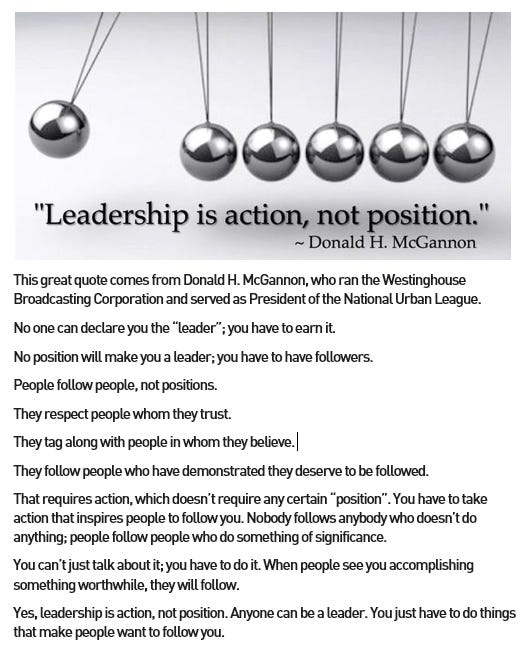
The key attribute you’ll need as a leader is the presence of mind required to perform with grace, composure, and effectiveness under pressure, and the knowledge that you can make a difference. Your group’s success requires you to “KASH” in with the Knowledge, Attitude, Skills, and Habits to get them there, and they’re counting on you.
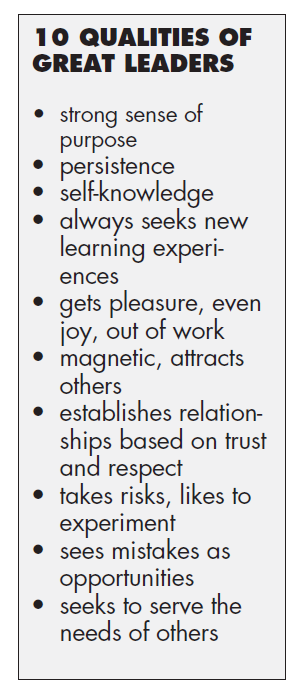
What’s in it for you? Becoming a leader is your opportunity to develop the 10 hottest transferable skills in today’s job market. According to Howard Figler in his book “The Complete Job Search Handbook,” the skills and experience employers look for are in the areas of:
•budget management
•supervising
•public relations
•coping with deadline pressure
•negotiating/arbitrating
•speaking
•writing
•organizing/managing/coordinating
•interviewing
•teaching/instructing
As a leader, you need to understand and be able to use different tools when leading and managing people. For every job, situation, and person there is an appropriate tool — you just have to understand who and what you’re dealing with, and which leadership style to use in that specific situation. The four leadership styles are directing, coaching, supporting and delegating. But before we get too far ahead of ourselves, there are some basic terms we need to define to clear up what is leadership — and what is not leadership.
Definitions
Leadership is any attempt to influence the behavior of another individual or group. It comes into play when you are working with other people. Leadership is not doing it yourself. Leadership is accomplishing tasks and reaching goals through the efforts of other people. Leaders use leadership to make things happen: They know what ought to happen; they plan a way to make it happen, and they take steps to see that it does happen.
Management is working with and through other people to accomplish organizational goals. Success has to do with how well the job gets done. Effectiveness has to do with people’s attitude about performing the work.
Readiness is how a person performs a particular task, and is not a personal characteristic. As a leader, you judge readiness in terms of the behavior you see.
How do you measure success?
Attempts at leadership are either successful or unsuccessful. In evaluating whether a leadership attempt has been successful, there are two criteria:
1) Did the job get done?
2) What impact did the leadership style have on the people being influenced? (Would they do it again? Just because it works once doesn’t mean it will work every time.)
How do you bridge the gap?
To bridge the gap between one-time success and long-term effectiveness, you need to develop three skills in working with people:
1) Understand people’s past behavior — Why did they do what they did? What motivated them?
2) Predict what people’s future behavior will be — How will they behave in the future under the same conditions, taking into account the constantly changing environment?
3) Direct, change and control behavior — You must accept responsibility for influencing the behavior of others in accomplishing tasks and reaching goals. This does not refer to the Machiavellian authoritarian “the end justifies the means” approach; rather, it refers to a mutually rewarding and productive relationship between you, the leader, and your followers.
These three skills determine whether your leadership attempts will be successful or unsuccessful, effective or ineffective.
What do leaders do?
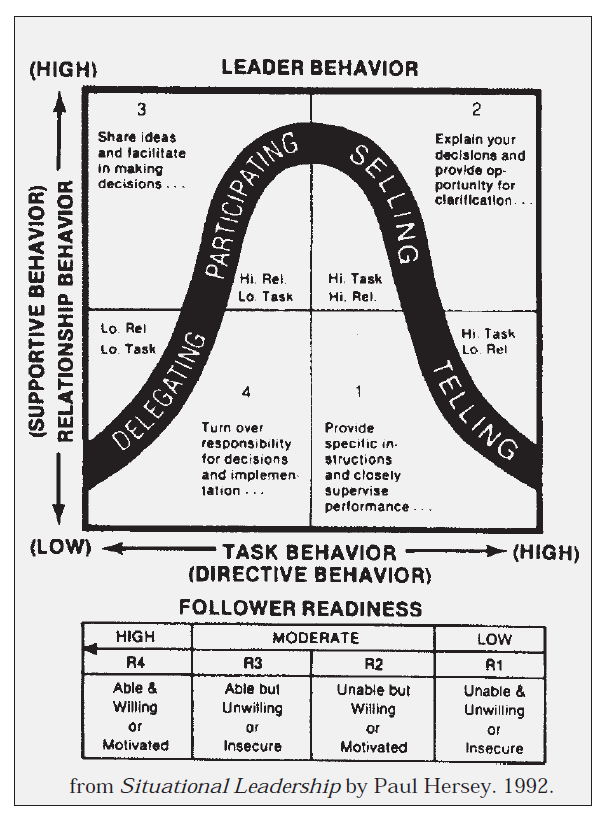
One of the pioneers in leadership research is Paul Hersey, who wrote the groundbreaking book “Situational Leadership” in 1992. Working with “One Minute Manager” author Ken Blanchard, the two offered Situational Leadership seminars, training materials, and publications for leaders and managers. Hersey writes that leaders must learn how to diagnose the ability and willingness of followers, and meet the demands of the workplace environment. Situational Leadership, then, is based on the interplay of three things:
1) The amount of task behavior the leader provides;
2) the amount of relationship behavior the leader provides, and
3) the readiness level of the followers.
This leads to the selection of an appropriate leadership style for a given follower in a specific situation.
When attempting to influence others, your job as leader is to:
1) diagnose the readiness level of the follower for a specific task, and
2) provide the appropriate leadership style for that situation.
That is, you relate the four readiness levels of your followers to the four basic leadership styles.
Follower readiness
To what extent does the follower have the ability and willingness to accomplish a specific task? Readiness is how a person performs a particular task. Leaders need to judge readiness in terms of the behavior you see, as readiness levels vary. Leadership style depends upon the follower’s Readiness Level. The leader must use a combination of high or low task behavior, or directive behavior, and high or low relationship behavior, or supportive behavior:
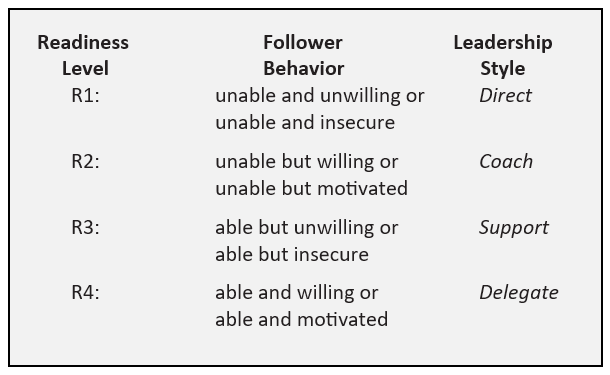
Leadership Style
For Readiness Level 1, the leader must provide specific instructions and closely supervise the performance of the follower through directing behavior, which is highly directive and low on supportive behavior.
Effective: In order to met the deadline, the editor takes control and assigns various people to complete various jobs. There is little time to develop two-way communication, explain decisions, or ask if there are any questions. Orders are issued without explanation and followers are watched closely.
Ineffective: An experienced group of journalism students decide to produce a supplement. The editor sits them down and gives them detailed instructions about who is to do what.
For Readiness Level 2, the leader must explain decisions and provide the opportunity for clarification through coaching behavior, which is highly directive and highly supportive behavior.
Effective: A talented writer is promoted to Sports Editor, and is eager to get started, but is unsure about how to go about it. The editor explains what needs to be done and why each step is important. The editor has time to answer any questions the new section editor may have.
Ineffective: In a meeting where every section editor knows as much as the editor, the editor makes the decisions and gives explanations to the section editors.
For Readiness Level 3, the leader supports the follower by sharing ideas and facilitating decision-making, which is highly supportive of the follower and low on directive behavior.
Effective: A reporter is about to begin on her first major assignment, but is still unsure of her abilities. Having confidence that she can do it, the editor provides plenty of support and encouragement, and is available to discuss the story after it is turned in.
Ineffective: Never having done a layout before, a staff member asks the editor for directions on how to complete the project. The editor responds by asking for suggestions from the staff member, even though the staff member does not have a great deal of knowledge or experience to complete the layout.
For Readiness Level 4, the leader delegates responsibility for decisions and implementation to the follower, which is low on directive and relationship behavior because the follower is highly competent and trusted based on the leader’s previous experience with that person in a similar situation.
Effective: A staff member always gets his or her stories and photos in on time and does good work. The editor lets the staff member do his or her job with little input or direction.
Ineffective: A new staff member is having trouble but the editor doesn’t take the time to help her or answer her questions. The writer is frustrated, and so are the other people who are depending upon her for the story.
You can see how Situational Leadership can be useful when applied to school and publications leadership challenges. There’s plenty more you can learn about Situational Leadership; these are just a few basics to get you started on the road to successful leadership and management.
Remember, as a leader your role is to influence your followers. Some followers have all the necessary knowledge, skill, confidence, and commitment to do what needs to be done, while at the other extreme some have no knowledge, skill, confidence, or commitment. In the middle are many followers who are at various stages of readiness. Your job as a leader is to learn how to diagnose your followers’ ability and willingness, and recognize and appreciate the differences.
Your leadership style is not so much how you see yourself, but how others perceive you and interpret what you do. Your leadership style must meet the demands of your unique workplace environment. Good luck!
These quizzes and activities are designed for high school journalism student leaders within a standard period or block. You can design other role play activities for your groups. These strategies also work well for nonprofit organizations that rely on volunteers to lead the organization.
Q&A
1. What is the key attribute you’ll need as a leader?
2. What does “KASH” stand for?
3. What are the skills and experiences employers look for?
4. What are the four leadership styles?
5. How do leaders make things happen?
6. How do you measure success?
7. What are the three skills you need to develop in working with people?
8. What do these skills determine?
9. What must leaders learn how to do?
10. When attempting to influence others, what two things must you do?
11. What is follower readiness?
12. What is your role as a leader?
ACTIVITIES
Ask for two volunteers to role play characters in the following improvisational skits. Say “freeze” when you want them to stop, then ask them if it was appropriate leadership behavior for the person and the situation. Make up your own and add to the fun.
Skit 1
Editor: You are a veteran of the yearbook staff. You have won several yearbook JEA Write-Off contests. You want the best yearbook your school has ever seen, and you know exactly what you want. The mini-mag section is due in one month, and you are ready to work night and day to make it perfect. You call together the mini-mag section editor and staff and give them detailed instructions about who is going to do what and what it will look like and read like, down to the last detail. After all, it’s got to be perfect and you’ve got to tell your staff exactly what to do so you can achieve your goal
Staff member: You are a three-year veteran of the yearbook staff. You have won several state and national JEA Write-Off contest awards; one for yearbook copy, two more for yearbook layout. Now you are put in charge of the yearbook’s mini-mag, which must be completed in one month. You are eager to get started, since you know what to do and how to do it. You don’t have a great deal of time outside of class; after all, you’re on the basketball team and a class officer. You want to make the most of class time to get the job done.
Leader (analysis): This high-task, low-relationship approach is only effective in some situations. Meeting a deadline, for example, is a good time to be directive, telling and using one-way communication. It is really ineffective when you have an experienced staff member who knows what to do.
Skit 2 Sports Editor: You are a junior and you have just been promoted to Sports Editor. You are excited about this new job — after all, you worked hard to get here. You received a Gold Circle Award for your sports writing, and worked hard laying out pages. You are eager to get started, but you are not sure what it is that you should do at your first sports staff meeting. You don’t want them to think you’re an idiot. You realize you need some guidance from someone with experience and insight, someone who can tell you what you need to know or explain things to you. You want to clarify some things that are on your mind. You need someone who has the time to discuss these things with you.
Editor: Your best sports writer is the new Sports Editor. You are genuinely pleased, and you want to help in any way possible. After all, you’ve watched and nurtured this person since he/she was a cub reporter. You’re a senior and he/she is a junior, so you’ve been there: Just starting out as a section editor, having the skills but not always the confidence, needing someone who can guide you with those questions that pop up. Now you’re the head of the department and want to help those who are on their way up. You realize this person could be editor next year. You know he/she is smart, so you don’t have to tell this person what to do. You know the best thing you can do is provide guidance, explain the answers to his/her questions, tell him/her the key things he/she needs to know, and especially leave the door open for future two-way discussions and clarifications.
Leader (analysis): This high-task, high-relationship approach is effective when a person is ready and eager to get started but is unsure about how to do it. It is especially ineffective when everyone knows as much as the supervisor, when this approach would appear to be condescending, or at an editorial board meeting.
Skit 3
Design Editor: You are a great designer, if you do say so yourself, but you’re even better (if that is possible) at developing the artisté in others and bringing out their unique design sensibilities. You love sharing ideas, sometimes getting so many good ideas you feel like you’re bouncing off the wall. Rather than tell someone how to do something (which you believe stifles one’s innate creativity), you love to draw “it” out of them. You recognize that artists are temperamental, that it’s all a part of the game, so you’re not willing to change your general approach just because someone gets emotional.
New Page Editor: This is your first year/first issue on staff, and you’ve been asked to lay out page 3 of the next newspaper. You’re about to panic! You know nothing about layout. When you signed up for staff, you thought they just wanted you for your considerable writing talent. You decide to ask the design editor for Help! with a capital “H.” You just want some straight, simple answers to basic design questions. You’re not a layout artist — yet, although you do consider yourself an artist with words, if only they would let you write some! You just want to get the page design done so you can get back to your first love — writing.
Leader (analysis): This high-relationship, low task approach is appropriate when you know a person has the ability to do something that is new to them. All they need is a little encouragement, to be asked for their contributions, or for you to promote discussion with them. This is really ineffective when a person clearly does not have the knowledge or ability to do something.
Skit 4
Editor: Your best staff member is Rob/Robin. He/she always gets his/her stories and photos in on time and does great work. You are very busy, so you let him/her do the job with little input or direction. You feel all you really need to do is say, “Hi! How are things going?” Engage in small talk, and end by saying “Sounds great!” and “See you later!” even though you weren’t exactly paying attention to what he/she said. Such a competent staff member, and so many other problems to solve today.
Reliable, friendly talented staff member: You would be voted Most Valuable Player if there was such an award on your staff. (You really don’t think it is necessary. The fact that people depend on you and that you take pride in your work is enough recognition for you.) You always get your story or photos in on time, and you are frequently complimented on your work — by everyone. You are busy today, as usual, but never too busy to chat nicely with the harried editor for a moment. You know the editor is busy and trusts you, but you also like to tell the editor ever-so briefly how your current assignment is developing. Sometimes you suspect the editor is not listening, though, and it’s actually lonely when everyone knows you’re competent and can delegate work to you knowing it will get done and be quality work. As a plea for attention and to test whether the editor really is paying attention, you decide when you see the editor to tell him/her that your story on topless teens dancers is coming along quite well, thank you!
Leader (analysis): This low-task, low-relationship approach is effective in situations where people need little direction or two-way communication or supportive behavior. Be aware that a person in this situation can feel lonely and isolated; therefore, be sure to spend special one-one time with this person.
Favorites
Directions: Ask students to choose their favorite song. Analyze each student’s song in a class discussion.
Point: Since much modern popular music features songs with a message or image attached to them, this is a good activity to reveal much about each student. Ask lots of follow-up questions.
Life Collage
Directions: Put together a collage that will effectively portray the high and low points and shaping influences in your life.
Point: What results is a single artistic representation of who they are and the forces that helped mold their personalities, beliefs, convictions, fears, anxieties, insecurities.
What happens: They begin to talk about the interrelatedness of the events of their lives which they had not confronted before. They also begin to see the similarities and differences within the group.
1-3-6
Directions: Take one minute and have everyone write down their ideas. After one minute, have three people get into a group and put all their ideas on one sheet of paper. After three minutes, have six people (two groups) get in a group to put all their ideas down together onto a sheet of paper. After six minutes, choose three to five of the best ideas from each group to share with the class.
You’re An Animal!
Directions: What animal would you pick that best represents you? Why? Do other members of the class think another animal would be more appropriate? Why?
Point: Valuable insights will occur after the laughing subsides.
What happens: Participants who wish to be lions or panthers, sleepy old dogs lying in the shade, or those who think they are tigers when the rest of the class thinks they are a jellyfish, are saying something about themselves.
Problem-Solving
Directions: Use the DESC script to teach people how to talk to each other when there is a problem: Describe what the person did; Explain how it made you feel; Say what the person needs to do to correct the situation; identify the Consequences if they do not correct the problem and meet your demands.
Cue Card Perceptions
Directions: Have one student give a report to a committee. While the report is being delivered, cue cards are held up so the group receiving the report can view them, but the student delivering the report cannot. The cue cards give a variety of instructions: Ignore me, tease me, humor me, etc. Do not overact. The reporting student’s task is to see if he/she can spot listener reactions comparable to those they will encounter when their committee work begins; to see if they are getting their point across, and if they are being listened to or merely heard. Can they alter their delivery to bring the group around?
-30-
What would make this more helpful for your group? Share your comments in Chat or email me.
Rob Melton is a reader-supported publication. To receive new posts and support my work, consider becoming a free or paid subscriber.
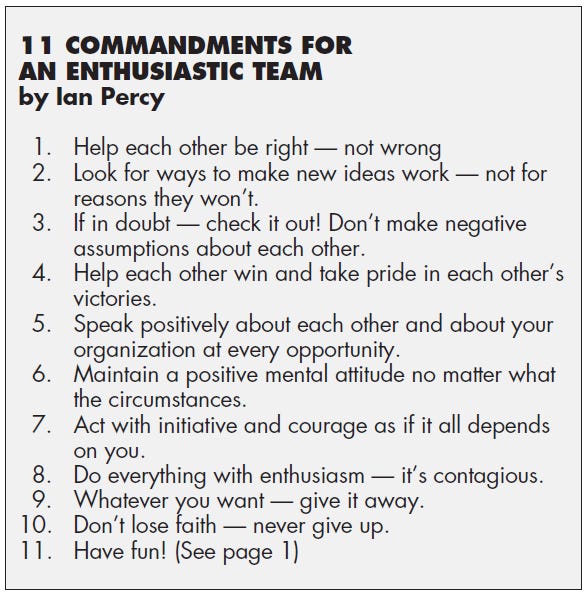
In this piece you can see how the leadership strategy is also a part of the strategies to engage students, especially #4.